

As parents, we spend a lot of time watching our children to make sure everything is okay. But detecting a vision problem in our little ones is not always easy.
And yet, if left untreated, these vision problems can have a real impact on children's lives, particularly on their academic development.
So, how can you recognize the signs of an eye problem in your toddler, and how can you tell if they need to wear glasses? We'll tell you everything!
Children's eyes: why should we take care of them?

Babies' and young children's eyes are extremely fragile, much more so than ours.
Why? Simply because children's pupils are larger than adults'. They therefore let in more light, especially blue light and ultraviolet rays.
And since their lens does not yet fully filter light, the effects of blue light on babies' and children's eyes can be magnified.
As you can see, it is important to take care of fragile eyes and have regular eye exams for babies and children.
The three essential tests that should be carried out by a specialist to examine children's eyes are: an initial exam a few days after birth, then at 9 months and two years.
This way, the professional can make sure their vision is correct for their age or detect if baby has a problem and may need glasses.
Then, when they start primary school, it is essential to have an eye exam. It is recommended to have one every year to monitor their vision, especially if your little one already wears prescription glasses or contact lenses.
Does my child need glasses? The signs that should alert you

It is not easy to know if your child has a vision problem, especially since they are unlikely to talk about it.
➡️ Some signs may, however, make you suspicious and prompt you to consult an ophthalmologist:
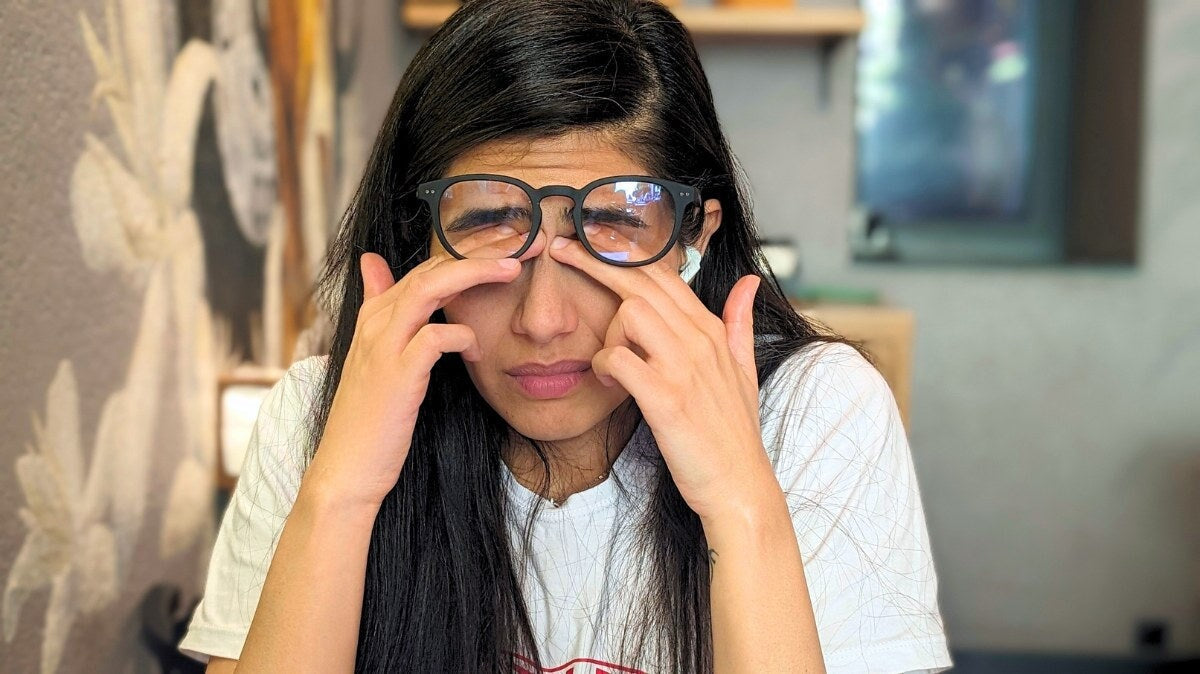
- 😉 Frequent blinking, excessive rubbing
- 😭 Crying eyes frequently
- 🤯 Headaches at the end of the day, migraines
- 🫣 Light sensitivity
- ❓ Learning difficulties at school, developmental delay, concentration problems
- 🤔 Short attention span
- 🥱 Fatigue
- 📺 Your child squints, tends to move closer to what they want to see (too close to the TV, for example)
Other behaviors may indicate a vision problem:

- 🖍️ If your child tends to draw crookedly or not write on the lines
- 🤨 If they cross their eyes or frown
- 🔠 If they confuse certain letters
- 🤕 If they bump into things regularly or have difficulty orienting themselves
- 🫨 If they turn or tilt their head in an unusual position to see properly
- 😑 If they cover or close one eye
- 📖 If they read too closely, use their finger to follow sentences, or read the same thing several times
The different vision problems in children
Rest assured, recognizing your child in the signs mentioned does not necessarily mean they have a visual impairment.
And if that is the case, it can be completely resolved if treated in time, so don't worry!
However, we strongly advise you to make an appointment with an ophthalmologist to have your child's eyes examined and determine whether wearing prescription glasses is necessary.
But what are the most common visual anomalies in young children?

- Myopia: when a child is nearsighted, they see well up close but have difficulty seeing far away.
- Hyperopia: conversely, they see well far away, but their close-up vision is not clear.

- Astigmatism: they perceive objects in a distorted way and see poorly both up close and far away.

- Strabismus: the two eyes do not look in the same direction due to a misalignment.
- Eye strain related to screens: with increasing overexposure (already 52 minutes per day for two-year-olds between 2013 and 2017), children's eyes are heavily strained and damaged by the harmful blue light emitted by them. If you want to know more, we have written a detailed guide on screens and children, the potential dangers, and the best practices to adopt.
According to the Asnav (National Association for the Improvement of Vision), one in seven children is born with a vision problem every year in France.
Later, one in four children would have a visual impairment between 5 and 6 years old. After 6 years, myopia develops and affects about 30% of those under 20.
When should you consult an ophthalmologist for your child?

It is important to consult as soon as you suspect a vision problem in your child.
If there is a family history or if your baby was born prematurely, they are more likely to develop a vision problem. In this case, you should take them to see a specialist regularly.
If in doubt, this eye exam will help detect a possible visual impairment in the child. To do this, the professional performs several tests. They measure visual acuity, both near and far, and the extent of the field of vision using drawings for the youngest and letters for the older children. They check the balance of the eyes, ocular motility, and perform a fundus examination.
Depending on their findings, they may prescribe corrective glasses or simply sessions of rehabilitation with an ophthalmologist, optometrist, or orthoptist to train their eyes to see better.
If your child does need glasses, don't hesitate to support them through this step by letting them choose the color and shape of the frame. Opticians now offer lightweight, comfortable children's glasses with good support. Don't hesitate to ask the optician for advice on equipping your little one with blue light blocking glasses for children.
You will then need to check in regularly to determine if they need new glasses.
💡 Good to know: do not underestimate the importance of consulting an ophthalmologist if you feel your child has difficulty seeing properly. It is essential for academic success. Indeed, 80% of the development of the visual system determines the child's overall development, and 90% of learning is done through vision ( source: Asnav ).
Good advice to avoid vision problems

In addition to the regular exams necessary to maintain healthy vision in children, there are a few tips to limit the development of visual impairments:
- 🧘 Take frequent breaks when spending time in front of screens: to rest the eyes and limit eye strain, make your child lift their head up a little. For example, you can implement the 20-20-20 rule, which consists of having them look every 20 minutes at an object 20 feet away (that is 6 meters) for 20 seconds
- 📱 Maintain a good distance from screens: make them maintain a distance of at least 2 meters when watching TV and 55 to 65 cm for others (computer, phone, tablet...).
- 🎨 Maintain the right distance for close-up activities: establish a distance of at least 30 to 40 cm for reading, drawing, and other manual activities
- ⚽ Encourage outdoor activities and play: at least 45 minutes a day when possible
- 🤓 Protect their eyes from screens with blue light blocking glasses : the harmful effects caused by the blue light from screens are a real concern. So even if they don't have a vision problem, equip your little one with a beautiful pair of glasses whose lenses filter this pesky light. You can take a look at our children's frames: guaranteed ultra-resistant and durable!
- 🕶️ Protect their eyes with sunglasses : to preserve their vision in all circumstances, don't forget to provide them with a suitable pair as soon as it is sunny. Opt for category 3 sunglasses to protect your toddler's fragile eyes.
Final word: how to know if my child needs to wear glasses?
Do not neglect your child's vision: vision problems can have a major impact on their life, particularly in the academic field.
The signs that should alert you: they complain of poor vision or blurry vision, see poorly on the board at school, squint. The same goes if they move closer to the TV or their book, complain of headaches at the end of the day, have difficulty concentrating... At the slightest doubt, do not delay in consulting a healthcare professional who can then perform all the exams to find out if corrective lenses are necessary.
You can also establish certain good habits that help limit the appearance of these disorders: limit screen time, protect your child's eyes from blue light, encourage outdoor activities, for example.