



Finding a pair of blue light glasses for a child is not easy. Even for adults, the market is still too underdeveloped for now, and few brands, like Horus X, are willing to best inform their visitors about the proposed filtration. For children, one might eventually think that the majority of companies do not care about them. That is why we want to help you by offering both a selection of the best blue light glasses for children, as well as a buying guide.
Which model to choose for a child? Top 3 best frames
1 - Horus X - Gaming Small, the best quality for the best price

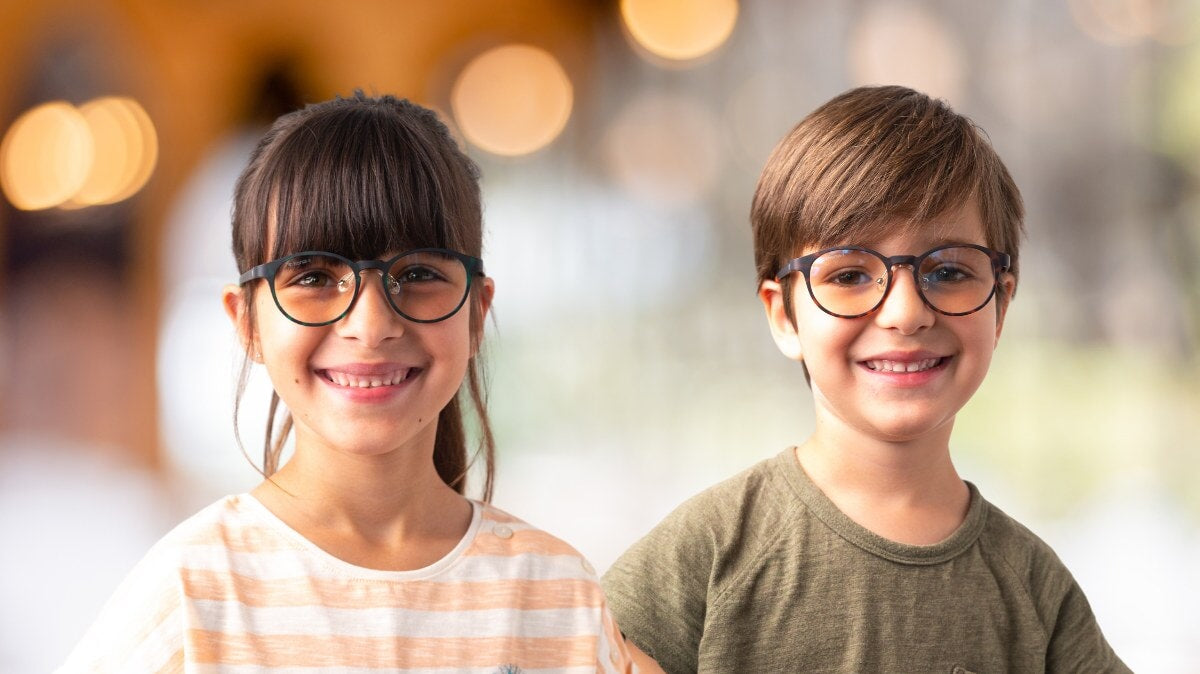
Yes, these are our own glasses. But what can we say, we are proud of them. Our team worked hard on each model already available for purchase, as well as those to come (did you see the little teaser?). In addition to offering frames adapted for adults with our best gaming glasses, we decided to offer the Gaming pair in a "Small" version, designed for children's small heads (among others). Even though the size is reduced, the protection is strictly the same as for the Gaming 2.0 pair. This makes them one of the most powerful blue light glasses on the market.
We are always very transparent about it, and that is one of our values: the idea is to help you, to protect you, not to provide you with inaccurate data. You should know that the Gaming Small blue light glasses filter more than 86% of harmful rays (380 to 450 nm) thanks to the tinted lenses, which also limit color distortion.
And the child's small head wearing them will not be uncomfortable: the glasses weigh only 20 grams, while the nose pad and temples are designed so that the frame can be worn for hours, even with a gaming headset over the ears. Eye protection is of such importance that it would be a real shame to sacrifice comfort, right?
Pros:
- Highly affordable price
- Clearly indicated filtration
- Overall comfort
- Protection effectiveness
Cons:
- Not available in prescription
2 - Gunnar - Cruz 12+, the prescription pair for children

A particularly expensive pair but with correction, the Cruz 12+ from Gunnar still manages to show its qualities. In addition to the size obviously designed for children and teenagers (otherwise we wouldn't be mentioning it here), the pair was designed to be durable.
It is not unreasonable to say that children's glasses are better off being shock-resistant; our toddlers, whether young or a bit older, inevitably tend to be less careful with these types of things than an adult. Just look at the state of Nintendo 3DS consoles sold on Leboncoin in bundles with games to understand who used them. The weight is 23 grams, and everything is designed to be comfortable in the long term.
Pros:
- Filtration of your choice
- Prescription glasses
Cons:
- Very expensive, due to costly correction
- Lack of transparency regarding the filtered spectrum and the actual protection provided.
3 - Lusee - Kids, the lovely pair with light filtration

Less well-known than the others, Lusee is also a French brand that manufactures blue light glasses. One of their models, the Kids, is designed for children. Offered at an affordable price, it is suitable for children aged 3 to 14, depending on the size and shape of their face, of course.
The main advantage of this pair is arguably its design, which is very child-friendly. But the downside is a cruel lack of information about the lenses. Apart from the filtration, which seems light given the color of the lenses (but that is a choice to be made, and we will talk about it below), the only technical information given is "UV400", which is too vague.
Pros:
- The frame design, different from what is usually found on this market
- Very affordable price
- Relatively light weight (27 grams)
Cons:
- Too little information on filtration
Are blue light glasses really important for children?
You probably know that children are generally more fragile than adults. Not that they are made of sugar, but the fact is that their bodies are not yet fully developed. It is interesting to note that before adolescence, a child's crystalline lens is not yet fully developed like an adult's.
Being more fragile, it will also filter light less well in general and consequently let in too much harmful blue light. But even after this stage of life, once they are teenagers, it is necessarily important to protect their eyes for the simple and good reason that any damage that could occur will remain for life, and it is a real shame to start damaging their eyes so early.

The risks of blue light, for children and adults
According to ARCEP, 93% of children aged 12 to 17 owned a phone in 2016. In 2021, there is no doubt that the figures are even more impressive. In addition to smartphones, a large number of children play video games, regulated or not by parents, and sometimes from a very early age, as early as 3 years old. Like an adult, and even more so depending on their age, their eyes will therefore be exposed to the harmful part of blue light. As a reminder, this causes certain risks in the short and long term:
- Eye fatigue: eyes sting, become red, may tend to water, be easily dazzled, and consequently create headaches. The quality of life, even for a child, is therefore already diminished;
- Sleep difficulties: obviously, if the quality of life during the day is lower, the quality of sleep at night is impacted. Headaches and general eye fatigue can tend to prevent sleep. But that's not all: blue light is an indicator for the brain that it is still daytime, since the sun also emits it. If the brain thinks it is daytime, why would it be ready to sleep? As you can see, staying in front of a screen all day, and especially in the evening, will deceive your body, making it harder to fall asleep;
- Long-term dangers: rarer but not non-existent, the long-term dangers caused by harmful blue light are a reality. Prolonged exposure to this light can cause irreparable damage to your eyes, while contributing to age-related macular degeneration, or even... causing blindness. For the youngest, there is even a direct link between blue light exposure and attention deficit hyperactivity disorder (ADHD).
To answer the question asked, the answer is yes: blue light glasses are obviously important for children. Whether it is to protect them as soon as possible or to instill healthy lifestyle habits, equipping them with gaming glasses adapted for children is a good idea, or even a duty.
How to choose the right frame for a child?
Choosing a frame for a child is not necessarily the same as choosing for an adult. Given their specific needs (durability and size), one will very often have to sacrifice the choice of the frame's design. It's a fact that children's glasses are generally less numerous than those for adults; you only need to go to an optician to realize this.

In the blue light glasses market, the observation is even more striking since there are, by default, fewer frames than prescription ones. Here are some details to take into account when choosing:
- Durability: As we said above, a child is not necessarily the human who will take the most care of their belongings. Depending on their age, they will tend to run in the playground, bump into things, leave them somewhere, and sit on them... In short, the frames must be at least somewhat durable;
- Frame size: A child's age influences the size of the frame to choose. Between a 4-year-old toddler and a slightly older 17-year-old (much taller, then), it is obvious that the size of the frame as well as that of the lenses will differ. You must therefore remember to measure their little head;
- Intended use: If a choice is available regarding the type of filtration, it is good to think about which one to use. If the child only needs glasses to play on a screen, then strong filtration is appropriate. If it is more for working and learning on a screen (tablet, computer), glasses with clearer lenses may be sufficient;
- Price: It is quite logical not to want to invest hundreds of euros in blue light glasses for a child if they are not prescription. The child will grow, and the frame will need to be changed several times until they finish growing.
Have you found the winning pair for your child?
As you have seen, blue light glasses have a real interest for children, both very young ones and teenagers. We must take care of them and their eyes from an early age, given the resurgence of screens in our daily lives. We hope that this guide has helped you find what you were looking for, or at least helped you discover useful things.
If you have been able to get the right pair for your child, do not hesitate to let us know. And if you think you need them for yourself too, we have guides designed for women as well as for men!