




You’ve reached the final round of Fall Guys, having navigated the craziest obstacles, when suddenly, you’re hit with severe dizziness. Although this usually doesn't indicate anything serious, it can be a symptom of eye strain that shouldn't be taken lightly. So, if these dizzy spells are regularly interrupting your joy of probably becoming one of the best players in the world (with all due modesty, of course!), this article will help you understand where they come from and what to do to avoid them.
Eye strain: what is it?
Today, screens are omnipresent in our lives: whether it's at work in front of a computer or at home, where we spend our time in front of the television, on the computer, tablet, phone, or e-reader, our near vision is increasingly taxed.
⏳ This prolonged use of screens and exposure to artificial blue light are obviously not without consequences and expose us to certain health risks. Eye strain, also known as asthenopia, is one of them, and along with it, these famous dizzy spells, as inseparable as Ratchet and Clank.
Why do screens cause eye strain?
A quick explanation of how your eyes work:
The vision process is a bit complex, but basically, your eye is made up of two parts:
- 👀 the eyeball, which receives visual information
- 🧠 the optic nerve, which connects the eyeball to the brain.
In addition to blood vessels, each of your eyes is surrounded by extraocular muscles for mobility, allowing you to look in all directions without any particular effort.

As mentioned above, our near vision is much more taxed, and to see up close, our eye must focus, a bit like when you tap your finger on your phone screen while taking a photo.
The eye muscles are then extremely stressed in order to provide the effort required for prolonged near vision.
👉 Like all organs in the human body, the eye can get tired, and that is how the first signs of eye strain appear.
Right now you're thinking that this accelerated mini-anatomy lesson is all well and good, but you still don't understand why the latest episode of The Last of Us gave you these dizzy spells you could have done without! Don't worry, we're getting to that!
The effects of screen blue light on your eyes
Have you noticed that your eyes usually start to feel tired after a day or a few hours spent in front of a screen?
And for good reason (pun intended!), screens and the blue light they emit are one of the main causes of eye strain.

Since blue light has a shorter wavelength than other colors, it penetrates the eye more easily and deeply, causing damage to the eyes.
Other causes
Put this way, it sounds like screens are the sworn enemy of your eyes like Emperor Palpatine, but they are obviously not the only ones responsible. Besides overconsumption of screens, quite a few other factors can explain eye strain, including:
-
☀️ The environment: sun, wind, cold, pollution, pollen, dust, humidity…
-
🚬 Cigarette smoke
-
♨️ Air conditioning and heating
-
🤧 Allergies
-
👓 Unsuitable optical equipment or uncorrected vision problems
-
💡 Inadequate lighting
-
🖥️ Poor work posture
-
😰 Stress
-
😴 Lack of sleep
-
🧓 Age: from 50 years old, people are more susceptible to experiencing eye strain and its symptoms
But by the way, what are the symptoms of eye strain?
The symptoms you shouldn't ignore
Whether they appear all at once or one after another, the symptoms of eye strain syndrome are the same:
-
🎯 Decreased visual acuity (sight gets worse throughout the day)
-
🌫 Blurred vision
- 👯♀️ Double vision
-
🌵 Dry eyes (ocular dryness), tingling, burning
-
🔴 Eye irritation, redness
-
📸 Accommodation problems (this is the difficulty in refocusing the eyes between distance and near vision)
-
🥴 Increased light sensitivity
-
😵 Discomfort or pain around the contour of the eye
-
🤯 Headaches (which can escalate to ophthalmic migraine)
-
😵💫 Dizziness (there it is, finally!)
Why do I have dizzy spells?
We don't necessarily think about it at first glance (did you notice the pun? 🤪) but eye strain, and therefore poor vision, can be two very common factors in the sensation of disorientation.
Let's remember that vertigo is a sensation of spinning felt while perfectly stationary.
👉 Intensive screen use and the resulting fatigue for the eyes, which are looking at something close up for a prolonged period, therefore lead to this feeling of lightheadedness.
Our tips for preserving your eyes and avoiding dizziness
Are your palms starting to get a little sweaty as you read our article because the symptoms mentioned, and especially these dizzy spells, sound familiar to you?
Don't panic, you can start to relax again because in the digital age, eye strain is a condition that affects three-quarters of the population.

So, no need to put tape on your TV screen or cancel your GamePass subscription, but rather apply these few recommendations and "remedies" to regain your balance:
-
🤓 Filter blue light from screens: we’ve said it before and we'll say it again, gaming glasses are the most effective way to filter harmful light waves from screens. Choose glasses with good filtration, perhaps the gaming collection or work collection from the French brand with the best filtration on the market (but yes, by chance).
-
⓴ Try the 20-20-20 method: as the name suggests, the principle is to look at an object 20 feet (6 meters) away from you every 20 minutes for 20 seconds. In 20 seconds, your eye will have had time to relax and will be ready to start again for its next intensive screen session (but until the next break in 20 minutes if you’ve been following along).
-
☕️ Take the time to rest your eyes: it seems obvious, and yet we don't always do it, but a break of about 5 to 10 minutes every 2 hours is very beneficial for your eyes. You can also take the opportunity to do some "eye gymnastics" 🤸 (yes, yes, this eye sport really exists!)
-
🔃 Adjust your position and your work and/or gaming station: to limit eye strain as much as possible, ensure that your screen is at the right height and adjust the brightness to avoid glare and reflections. Also, be careful to adopt a good posture.
-
🥗 Prioritize antioxidant-rich foods: don't hesitate to incorporate fresh vegetables, fruits, eggs, or even nuts and fatty fish into your diet. They are filled with useful nutrients for your beautiful eyes.
-
💧 In case of dry eyes, you can use certain medications like artificial tears or eye drops to properly moisten your eyes.
-
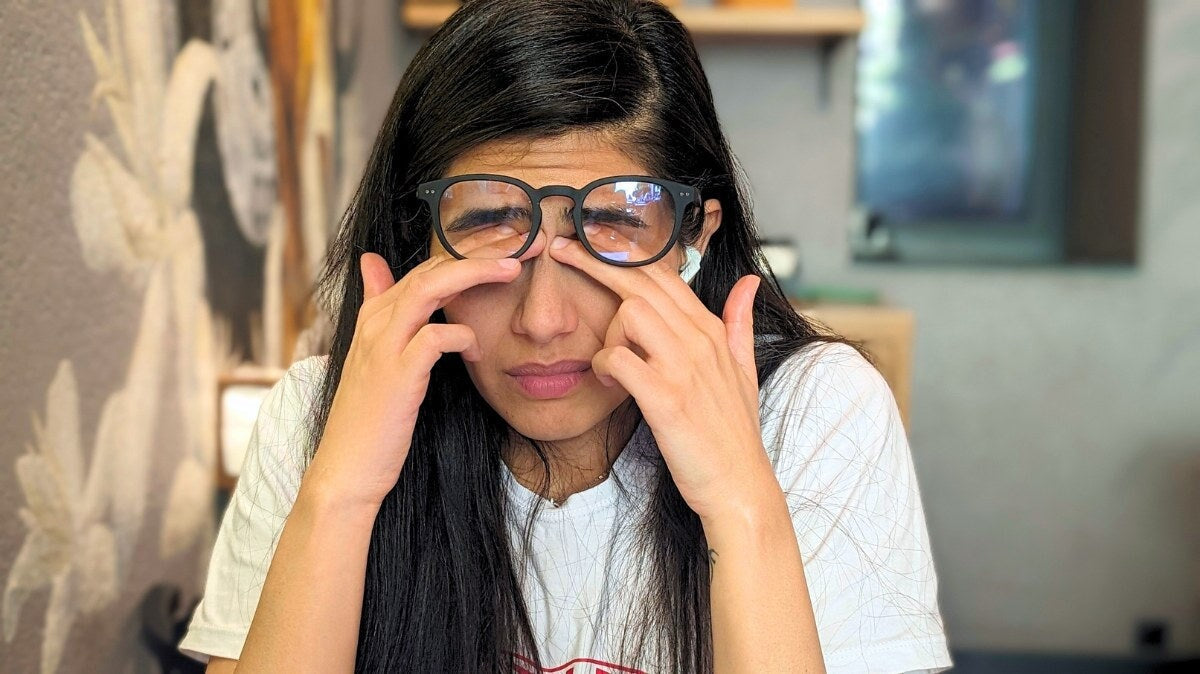
🫣 Eye massage: it might not sound as dreamy as a classic massage, but your eyes will thank you!
-
🏋️ Exercise: nothing like it to reduce pressure, hit "reset," and give your eyes a chance to rest a little.
When should you consult a doctor?
If despite all these tips, your eye strain and dizziness problems persist and prevent you from fully enjoying your days, it is then recommended to consult an ophthalmologist.
👩⚕️ Eye exam
After an in-depth ophthalmic assessment, your ophthalmologist may prescribe various solutions such as orthoptics sessions (a form of physical therapy for the eyes), which are very effective against eye strain.
If you wear glasses or contact lenses, they will check that your prescription is still correct and that there are no uncorrected visual disturbances.
They may also perform an eye test to ensure that the eye strain is not linked to other vision disorders like astigmatism, myopia, hyperopia, presbyopia, etc.
🩸 Blood test
If all these tests are still not enough to determine the origin of the eye strain, and with it the dizziness, a blood test may be carried out to check for possible nutritional deficiencies and diseases unrelated to the eyes (Ménière's disease, for example).
Finally, be aware that taking certain medications, such as diuretics or antidepressants, can also explain eye strain and the feeling of dizziness.
Final word: Dizziness and eye strain
We hope we haven't made you feel even more dizzy with all this information, but if there are things to remember, it's this: with eye strain becoming increasingly frequent, dizzy spells are also becoming more common.
Fortunately, no need to throw all your screens out the window to avoid them, but just apply these few tips to keep them away from you as much as possible (Mordor is fine, but from a distance): filter harmful blue light from screens, take care of your eyes, and remember to rest them regularly, adopt a healthy lifestyle, and opt for a diet rich in antioxidants. And if you have the slightest doubt, don't hesitate to consult a professional!


Comments
Un grand merci pour vos conseils je commençais à avoir depuis quelques jours des vertiges le soir en regardant la télé j’ai trouvé ma réponse.