



What is blue light?

We know you're an expert on the subject thanks to us, but for those who prefer to play Hogwarts Legacy rather than read our articles on this light (no judgment, we get it), a quick reminder surely won't hurt!
A wavelength present in excess on our screens
Blue light is the part of the light spectrum with wavelengths between 380 and 500 nanometers.
If we are hearing more and more about it today, it's simply because screens, now omnipresent in our daily lives, whether at work or at home, are one of the sources of (artificial) blue light.
Indeed, blue light is found:
-
☀️ in the daylight spectrum emitted by the sun
-
📱in the screens that surround us (phone, computer, tablet, television…)
-
💡in modern LED lighting
There are two categories of blue light
-
Turquoise (between 450 and 500 nanometers), which is good for morale and essential for regulating our biological rhythm
-
Blue-violet (between 380 and 450 nanometers), potentially dangerous, which carries health risks and to which we are increasingly exposed. It sits between turquoise blue light and ultraviolet rays, better known as UV, which are particularly harmful to the skin.
Overexposure can lead to certain problems
-
😴 sleep and falling-asleep disorders
-
🤯 headaches
-
😵💫 eye irritation, stinging, and blurred vision
-
👀 eye strain
If you want to know more, don't hesitate to take a look at our complete guide on this light and its effects.
It often plays the villain, but let's not forget that what represents a danger to your health is the artificial blue light from screens when you are exposed to it at high intensity and for a prolonged period. Basically, where you run the most risk is when you stare at a screen for too long, for example while watching the latest episode of The Mandalorian in the dark or finishing your game of Resident Evil 4, still in total darkness. Conversely, natural blue light is not harmful (up to a certain level of exposure and intensity, of course).
How does blue light cause the appearance of wrinkles?

As blue light is the most energetic wave of the visible light spectrum, it penetrates more deeply into the superficial layers.
Its waves are very short and therefore potentially more irritating to the skin. Recent studies highlight that overexposure to this light emitted by our screens would accelerate skin aging, but is that really the case?
The theoretical problem raised
A French study warns that it leads to cellular exhaustion and possible oxidative stress. Much like the sun's UV rays, it would penetrate the skin to destroy collagen, thus leading to premature aging.
Blue light could therefore cause significant damage to our skin as it:
-
🔴 causes oxidative stress
-
💪 reduces the production of fibroblasts
-
🧬 damages cellular DNA and oxidizes their membranes
If the skin loses elasticity and becomes more fragile, the consequence is clear:
👉 your skin ages faster and wrinkles therefore appear prematurely.
The practical problem to put into perspective
However, be careful! These studies should be taken with a grain of salt, and for now, the biological effects of repeated, long-term exposure to blue light are not yet fully proven.
There are only a few studies on the subject and they are based on fairly limited criteria.
In reality, most studies have shown that sunlight is much more dangerous to the skin than that of our screens: excessive exposure to the sun's ultraviolet radiation causes real skin lesions (visible ones) leading to skin aging, where it thins in places and loses elasticity.
At the same time, brown spots, patches, and wrinkles can appear.
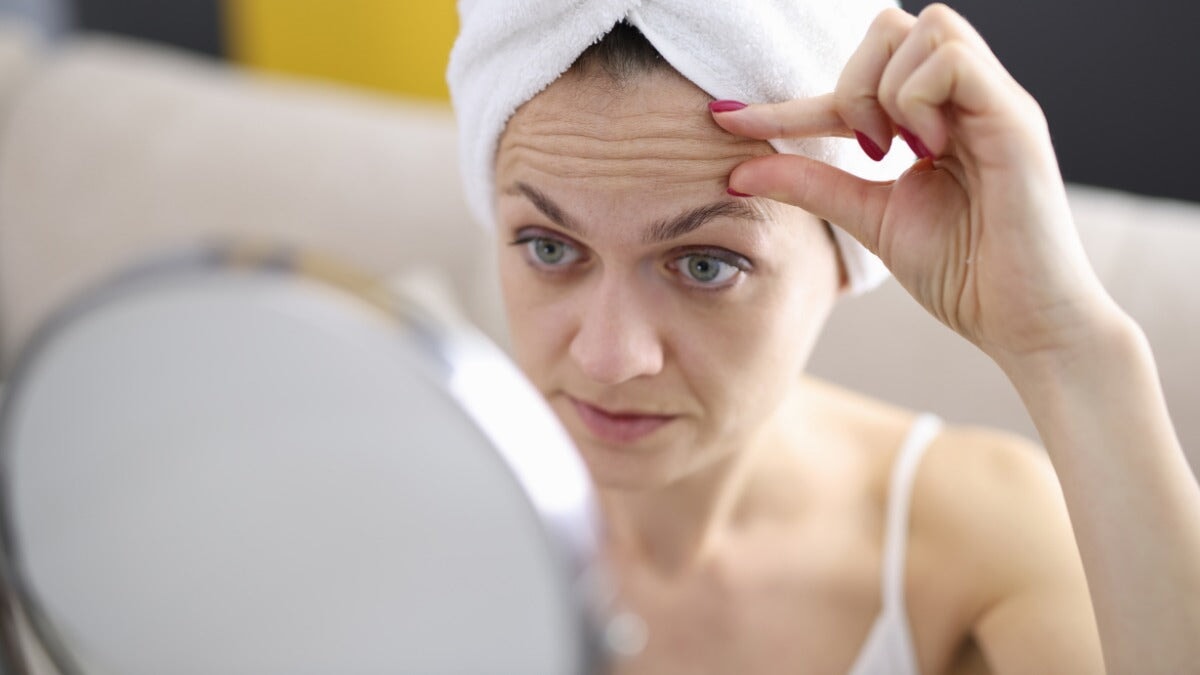
You are surely scrutinizing yourself in the mirror looking for the first wrinkles on your face, but unfortunately (or fortunately!), you won't see them right away. Indeed, premature skin aging is a process that takes time, and wrinkles can only manifest after several years.
Now that that’s said, there's no need to rush to the pharmacy to buy all the anti-wrinkle creams on sale; there are much more effective (and above all cheaper!) ways to limit this phenomenon.
Habits to adopt to protect yourself and avoid wrinkles
Protecting yourself from blue light
You are probably starting to know them well, but it is always good to recall these few simple daily gestures that will be good for your skin (or at least not bad) but above all for your general health:
-
📵 Reduce your screen time, especially before sleeping: ideally, try to stay away from screens at least 1.5 hours before bedtime (maybe this is the time to bring out your old board games if you don't know what to do)
-
🌃 Activate "night" mode on your tablet and smartphone to protect yourself from waves harmful to the skin
-
💡 Lower the brightness of screens and LED lights (think about the lighting in your home in addition to screens).
-
👓 Choose an anti-blue light filter by wearing blue light blocking glasses (you can of course see our collections of glasses to find the ideal pair or read our guide on how to choose your anti-blue light glasses) and/or by placing a filter directly on your screen to limit the amount emitted
-
☀️ Prioritize natural light as much as possible
Create a natural shield by strengthening your warrior body
-
🥗 Eat foods rich in antioxidants and vitamins C, A, and E, which help protect the skin from oxidative stress caused by harmful rays
-
💧 Stay well hydrated: well-hydrated skin defends itself better against external aggressions like pollution, cold, and UVs
-
🧴 Be more attentive to your sun exposure. Honestly, if there is an enemy of your skin, it's overexposure to UVs. So, we avoid roasting like a big organic farm chicken in the sun all afternoon and we remember to put on a really good sunscreen.
The benefits of blue light

We tend to highlight the dangers of blue light to health, but we shouldn't forget that it can also have beneficial effects.
At low energy, a certain amount of exposure to blue light could help prevent certain skin diseases.
For example, it can be used for certain dermatological treatments and could be a formidable ally against acne.
Used in LED form (light therapy), it acts as an antibacterial agent capable of attacking the bacteria that cause those pesky pimples and even promotes healing. In this case, it would not be harmful to the skin. Of course, this type of treatment should be carried out by a healthcare professional (preferably a dermatologist) in order to receive the necessary dose at the right distance to avoid any risk. Also used in light therapy, it can be effective in fighting depression.
And if you want to know more about the effects of blue light on acne, you will find all the answers in this article where we show you the various studies on the subject.
Final word: impact of blue light on wrinkles
The premature appearance of wrinkles seems potentially linked to blue light, but for now, there is still a lack of sufficient evidence to state that it represents a major danger for the doomscroller that you are. There is a question of intensity that has not been analyzed enough. So, we are not too worried for you! So, before rushing to the latest miracle anti-blue light skin treatments, think about the essentials.
Don't forget that what causes this phenomenon is prolonged overexposure to harmful waves, and in this, UVs are the real enemies to target (waves up to 380 or even 400 nanometers). Regardless, you can already apply these few tips to delay the appearance of wrinkles; it's, once again, a question of common sense, and since we know you're full of it, you should survive your next hour of Call of Duty.